Packing for two weeks can make a perfectly reasonable person suddenly believe they need six pairs of shoes, three jackets, and enough underwear to survive a minor expedition.
The good news is that learning how to pack a suitcase for two weeks is much easier once you stop thinking about packing 14 separate outfits. The goal is to create a small, versatile travel wardrobe, use your suitcase space wisely, and have a laundry plan.
Whether you are heading to Europe, taking a beach vacation, going on a road trip, or visiting several destinations on one trip, a little planning can make a huge difference.
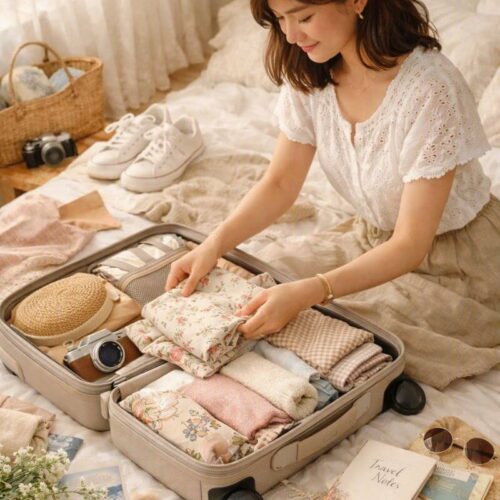
Here is exactly how to pack a suitcase for two weeks without turning your bedroom into a clothing explosion.
Start With Your Itinerary
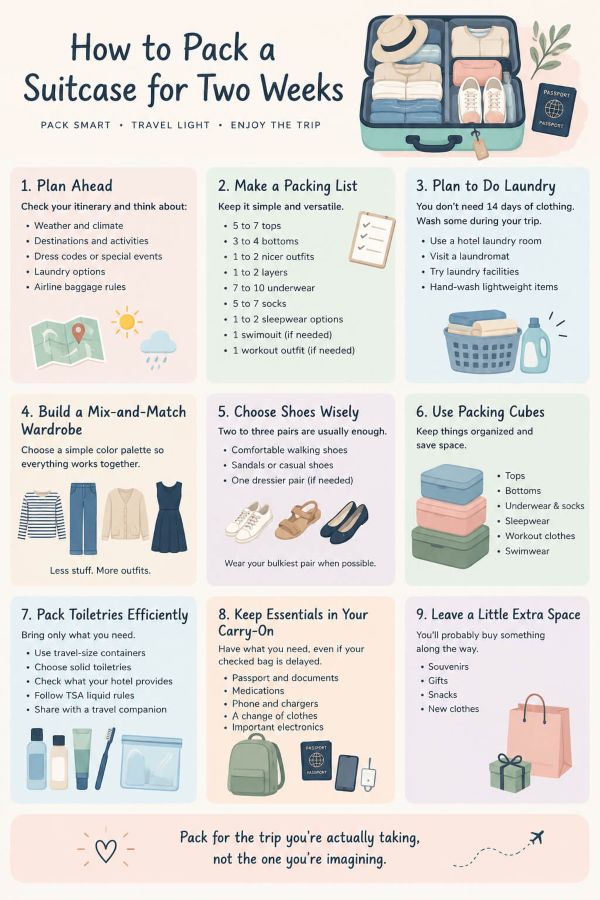
Before putting a single thing into your suitcase, look at your itinerary.
Consider:
- The weather at your destination
- How many destinations you will visit
- Planned activities
- Whether you need dressy outfits
- Whether you will have access to laundry
- Any dress codes or cultural considerations
- How much walking you expect to do
- Your airline’s baggage allowance and restrictions
This step matters because two weeks in Paris in autumn requires a very different suitcase from two weeks at a tropical beach resort.
If your trip involves several climates, make a list of the clothing you genuinely need for each one. You may discover that you can layer a few pieces rather than packing an entirely separate wardrobe for every destination.
It is also worth checking your airline’s current baggage rules before you pack. Size and weight allowances vary between airlines and fare types, particularly for carry-on luggage.
Make a Two-Week Packing List
A packing list is one of the simplest ways to prevent overpacking.
The trick is to write the list before you start filling the suitcase. Otherwise, the suitcase tends to become a black hole where “maybe I’ll need this” items mysteriously multiply.
For a typical two-week trip, your clothing list could look something like this:
Clothing
- 5 to 7 tops
- 3 to 4 bottoms
- 1 to 2 dresses or nicer outfits, if needed
- 1 lightweight sweater or cardigan
- 1 jacket or outer layer appropriate for the weather
- 7 to 10 pairs of underwear
- 5 to 7 pairs of socks, depending on footwear
- 1 to 2 sleepwear options
- 1 swimsuit, if needed
- 1 workout outfit, if you actually plan to exercise
- 1 comfortable travel outfit
These numbers are a starting point, not a law handed down by the International Association of Suitcase Inspectors.
Your actual needs depend on your destination and travel style.
The important part is that you do not need 14 tops and 14 bottoms just because your trip lasts 14 days.
Plan to Do Laundry
This is probably the biggest secret to learning how to pack a suitcase for two weeks.
You do not have to bring 14 days’ worth of clothing.
Plan to wash some of your clothes during the trip.
Laundry could mean using a hotel laundry room, visiting a laundromat, using laundry facilities at a vacation rental, or hand-washing a few lightweight items. Travel experts commonly recommend building laundry into a two-week packing strategy because it dramatically reduces the amount of clothing you need to carry.
For example, you could pack enough clothing for roughly one week and wash your clothes around the middle of your trip.
That means your suitcase only needs to accommodate a practical wardrobe rather than a full fourteen-day fashion show.
If you’re planning to hand-wash clothing, choose fabrics that dry relatively quickly. Lightweight synthetics and some wool garments can be particularly useful for travel. Heavy cotton pieces can take considerably longer to dry.
Build a Mix-and-Match Wardrobe
One of the best suitcase-packing strategies is to choose clothing that works together.
Before packing something, ask yourself:
Can I wear this with at least two or three other things I’m bringing?
If the answer is no, it may not deserve valuable suitcase real estate.
Choose a simple color palette so your tops and bottoms can be mixed and matched. Neutrals such as black, white, navy, beige, gray, denim, and brown are easy to combine, although you can absolutely add a few colors or prints.
For example, you could pack:
- Two pairs of versatile pants
- One pair of jeans
- Five tops
- One cardigan
- One lightweight jacket
- One dress
- Two pairs of shoes
Those pieces can create considerably more outfit combinations than you might expect.
The goal is to make your wardrobe work harder.
Choose Your Shoes Carefully
Shoes are often the biggest suitcase offenders.
They are bulky, oddly shaped, and somehow capable of taking up half a suitcase while contributing only one outfit.
For a typical two-week trip, two or three pairs may be enough, depending on your activities.
A practical combination could include:
- Comfortable walking shoes
- Sandals or casual shoes
- One dressier pair, if necessary
Wear your bulkiest pair during travel when practical.
Think carefully before bringing shoes that only work with one outfit. If you’re going to walk around a European city all day, for example, comfortable footwear is likely to earn its place in your suitcase much more often than those gorgeous shoes that become torture devices after 20 minutes.
Stuff socks or small soft items inside shoes to use the space.
Use Packing Cubes
Packing cubes can make a suitcase considerably easier to organize.
You can divide clothing into categories such as:
- Tops
- Bottoms
- Underwear and socks
- Sleepwear
- Workout clothes
- Swimwear
They are particularly useful if you’re moving between several hotels because you can remove an entire cube instead of digging through the entire suitcase every time you need a T-shirt.
Compression packing cubes can also help reduce the volume of soft clothing, although they do not magically make a suitcase lighter. If you compress more clothes into the same space, you can still end up with an overweight bag.
So use them to organize and manage space, not as an excuse to pack another seven sweaters.
Should You Roll or Fold Your Clothes?
There is no universal rule that every traveler must roll every garment.
Rolling can be useful for smaller, soft clothing because it makes individual pieces easy to see and retrieve. Folding works well for bulkier garments and structured clothing.
A combination of both methods is often practical.
Try rolling:
- T-shirts
- Tank tops
- Leggings
- Pajamas
- Lightweight casual clothing
Fold:
- Blazers
- Structured dresses
- Bulky sweaters
- Button-down shirts that wrinkle easily
You can also use packing cubes to keep rolled clothing contained and organized.
The best method is the one that lets you fit everything you need while keeping your suitcase manageable.
Pack Your Bulkiest Items Strategically
If you’re traveling somewhere cold, bulky clothing can quickly become the suitcase’s greatest enemy.
Instead of packing your heaviest coat, thickest sweater, and bulkiest shoes, consider wearing some of them while traveling.
A coat worn on the plane takes up considerably less suitcase space than a coat stuffed inside it.
Of course, comfort matters. You don’t want to board a long-haul flight looking like you are wearing your entire closet simply to save two inches of suitcase space.
Choose strategically.
Pack Toiletries Efficiently
Toiletries can take up an astonishing amount of space, particularly when you’re tempted to bring full-size bottles of everything.
Start by checking whether your accommodation provides basics such as shampoo, conditioner, soap, or body wash. If you’re happy using those products, you may not need to bring your own versions.
For carry-on travel, remember the applicable airport security rules. At U.S. TSA checkpoints, liquids, gels, aerosols, creams, and pastes in carry-on luggage generally need to be in containers of 3.4 ounces (100 ml) or less and fit into a single quart-size bag.
You can save space by:
- Using small refillable containers
- Choosing solid toiletries where practical
- Packing only the amount you expect to use
- Sharing certain products with your travel companion
- Buying basic toiletries at your destination when convenient
Don’t pack a giant bottle of shampoo because you are going away for two weeks. Your hair has no idea how long your vacation is.
If you are checking your suitcase, full-size toiletries may be permitted, subject to applicable airline and security restrictions. Place them in sealed toiletry bags to protect your clothing from leaks.
Keep Important Items in Your Carry-On
If you are checking a suitcase, don’t put everything you need in that suitcase.
Your carry-on or personal item should contain essentials you may need during the journey and anything that would be especially difficult to replace.
Consider keeping these with you:
- Passport and travel documents
- Wallet and payment cards
- Prescription medications
- Phone
- Chargers
- Important electronics
- Glasses or contact lenses
- Essential toiletries
- A change of clothes
- Basic underwear
- Any particularly valuable or irreplaceable items
Having a spare outfit with you can be particularly useful if your checked suitcase is delayed.
You may never need it. That is exactly why you’ll be delighted to have it if you do.
Pack Electronics Without Bringing Your Entire Desk
Electronics can quickly become another category of unnecessary clutter.
Think about what you will actually use.
A typical travel electronics kit might include:
- Smartphone
- Phone charger
- Power bank, where permitted
- Laptop or tablet, if needed
- Camera, if you use one
- Necessary charging cables
- Travel adapter for destinations with different plug types
Before your trip, check the plug type and electrical requirements at your destination, particularly if you’re traveling internationally.
Also download anything you may need offline, such as boarding passes, maps, hotel information, entertainment, or important travel documents.
That way, you’re not desperately searching for Wi-Fi at the airport while holding your phone at an angle like it is a divining rod.
Use Every Bit of Available Space
Once you’ve chosen what you’re taking, pack strategically.
Place shoes around the edges or at the bottom of the suitcase, depending on the suitcase design. Put socks and other small items inside shoes.
Use the spaces between larger items for smaller pieces.
Packing cubes can then be placed together to create a relatively organized interior.
For items that wrinkle easily, place them toward the top where possible and avoid crushing them beneath heavy objects.
Don’t forget exterior compartments. They can be useful for travel documents, accessories, or items you’ll need shortly after arriving.
Leave a Little Extra Space
If your suitcase is full before you leave, you have a problem.
Remember that you may buy something during your trip.
Souvenirs, clothing, snacks, books, gifts, and other purchases all need somewhere to go. A suitcase packed to absolute maximum capacity gives you no flexibility.
Leaving some room also makes repacking much easier.
And if you’ve ever tried to close a suitcase by sitting on it while another person wrestles with the zipper, you already understand why this matters.
What Not to Pack for Two Weeks
Learning how to pack a suitcase for two weeks also means learning what to leave behind.
Think twice about packing:
- Multiple pairs of shoes you rarely wear
- Several “just in case” outfits
- Full-size toiletries
- Clothing that only works with one other item
- Too many heavy sweaters
- Duplicate electronics
- Excessive accessories
- Items you can easily buy at your destination
The “just in case” category is particularly dangerous.
One “just in case” item is harmless.
Ten “just in case” items are how you end up paying an overweight baggage fee for clothing you never wore.
A Simple Two-Week Suitcase Formula
If you want a straightforward starting point, try this:
Clothing
- 5 to 7 tops
- 3 to 4 bottoms
- 1 to 2 nicer outfits
- 1 to 2 layers
- 1 outer layer
- 7 to 10 pairs of underwear
- 5 to 7 pairs of socks
- 1 to 2 sleepwear options
- 1 swimsuit, if needed
- 1 workout outfit, if genuinely needed
Shoes
- Comfortable walking shoes
- Casual or warm-weather shoes
- Optional dressier pair
Toiletries
- Toothbrush and toothpaste
- Skincare basics
- Shampoo and conditioner
- Body wash
- Deodorant
- Sunscreen
- Hair products you actually use
- Necessary medications
- Any personal hygiene essentials
Travel essentials
- Passport
- Travel documents
- Wallet
- Phone
- Chargers
- Travel adapter, if required
- Sunglasses
- Reusable water bottle
- Small laundry supplies
- Day bag or foldable tote
Adjust the list based on your destination, activities, climate, and personal needs.
Final Packing Check
Before zipping up your suitcase, do one final review.
Ask yourself:
Will I actually wear this?
If you hesitate, put the item aside.
Then ask:
Can I wear this with several other things?
If not, reconsider it.
Finally, check your itinerary again. Make sure you have what you need for special activities, weather changes, dressier occasions, and any destinations with specific clothing requirements.
Then weigh your suitcase if your airline has a weight limit.
That last step can save you from discovering at the airport that your carefully packed suitcase has apparently been eating rocks.
Final Thoughts on How to Pack a Suitcase for Two Weeks
Once you understand how to pack a suitcase for two weeks, the process becomes much less intimidating.
The key is not trying to bring an entirely different outfit for every day. Build a versatile wardrobe, choose pieces that work together, limit your shoes, keep toiletries practical, use packing cubes if they help you stay organized, and plan to do laundry during the trip.
Most importantly, pack for the trip you are actually taking.
If you’re spending two weeks hiking, you need hiking gear. If you’re visiting cities, comfortable walking clothes and shoes deserve priority. If you’re heading to a beach resort, your suitcase will look very different from one designed for a winter vacation.
A good suitcase should make your trip easier, not become another thing you have to manage.
Pack thoughtfully, leave room for souvenirs, and remember you are going on vacation. You do not need to bring your entire closet with you.
Follow me on:



Leave a Reply